

09/21/26
STORY
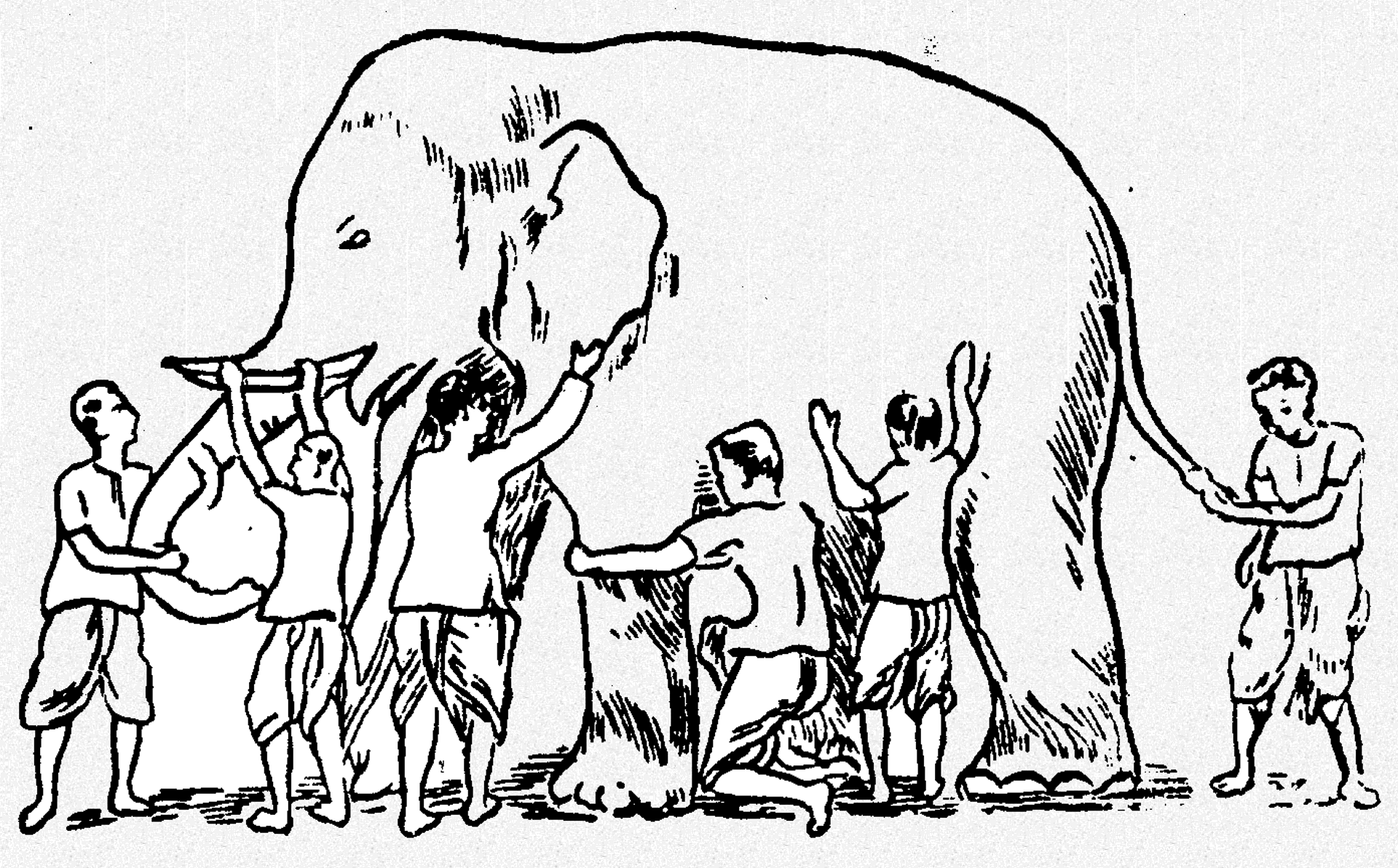
Six blind men encountered an elephant for the first time, and they wanted to figure out what it was.
One of the men went up to the side of the elephant and said,
“It feels like a wall.”
Another went to the front of the elephant and grabbed hold of its trunk.
“A wall? Feels much more like a snake to me.”
A third man reached for the elephant’s ear and said,
“It feels like a fan to me, guys.”
The fourth man grabbed hold of the tusk and proclaimed,
“I don’t know what you’re all talking about. It feels like a spear!”
A fifth man put his arms around the leg and shouted,
“I got it, fellas! It’s definitely more like a tree!”
The sixth man went to the back of the elephant, grabbed hold of its tail, and screamed,
“You’re all crazy! It feels like a rope!”
The six men argued, each convinced he was right.
You see the point, right?
The elephant represents something new, something different, an unexpected change.
So often, we look at a situation from one perspective, assuming we have it right.
Others may see things completely differently.
If we refuse to consider other perspectives, we’re not going to see the full picture.
When unexpected change arises, it’s easy to fall into silos.
The best thing we can do is to expand our view by collaborating with others.
Rather than assuming your perspective is the right one…
Be curious about learning from others.
How do they see things?
In addition to your initial thoughts about the situation…
How else could you be looking at it?
Through collaboration…
You can expand your view…
Be able to recognize “the elephant” for what it is…
And be more adaptable to unexpected change.
OBSERVATION
(The following observation was written with the help of AI)
Psychologist Lee Ross of Stanford University identified what he called “naive realism”: the deeply ingrained conviction that we perceive the world objectively, exactly as it is, and that anyone who sees it differently must be uninformed, irrational, or biased. It’s the same mistake each blind man made in the story: not just misjudging the elephant, but assuming his own partial experience was the whole truth, and that everyone else must simply be wrong. Ross’s research found this bias sits at the root of far more everyday conflict and misunderstanding than most people realize — precisely because it never feels like a bias from the inside.
(Ross & Ward, Naive Realism in Everyday Life: Implications for Social Conflict and Misunderstanding, 1996)
STRATEGY
Challenge your own perspectives this week.
When there is disturbance, change, or difficulty…
Be aware of your initial interpretation…
And get curious as to how others may see it.
Ask questions to learn about others’ perspectives on the challenge.
This will help you to expand your view and make better decisions.
Rooting for you,
Jay (inviting you to consider other perspectives)
International Keynote Speaker
Host of the “Unstuck” podcast
A New Jersey Pizza Connoisseur (Alex and I have a whole spreadsheet of pizza places near us, grading the quality of the pizza; we’re on a mission to discover the best pizza in the area!)

2 Comments
Obuqzlpr Vgkmfhccq
yakDCGZyQxjDcTdgcxLCqlf
Tagrg Bejpyepth
vTINhnKrlETPJqoEhZG